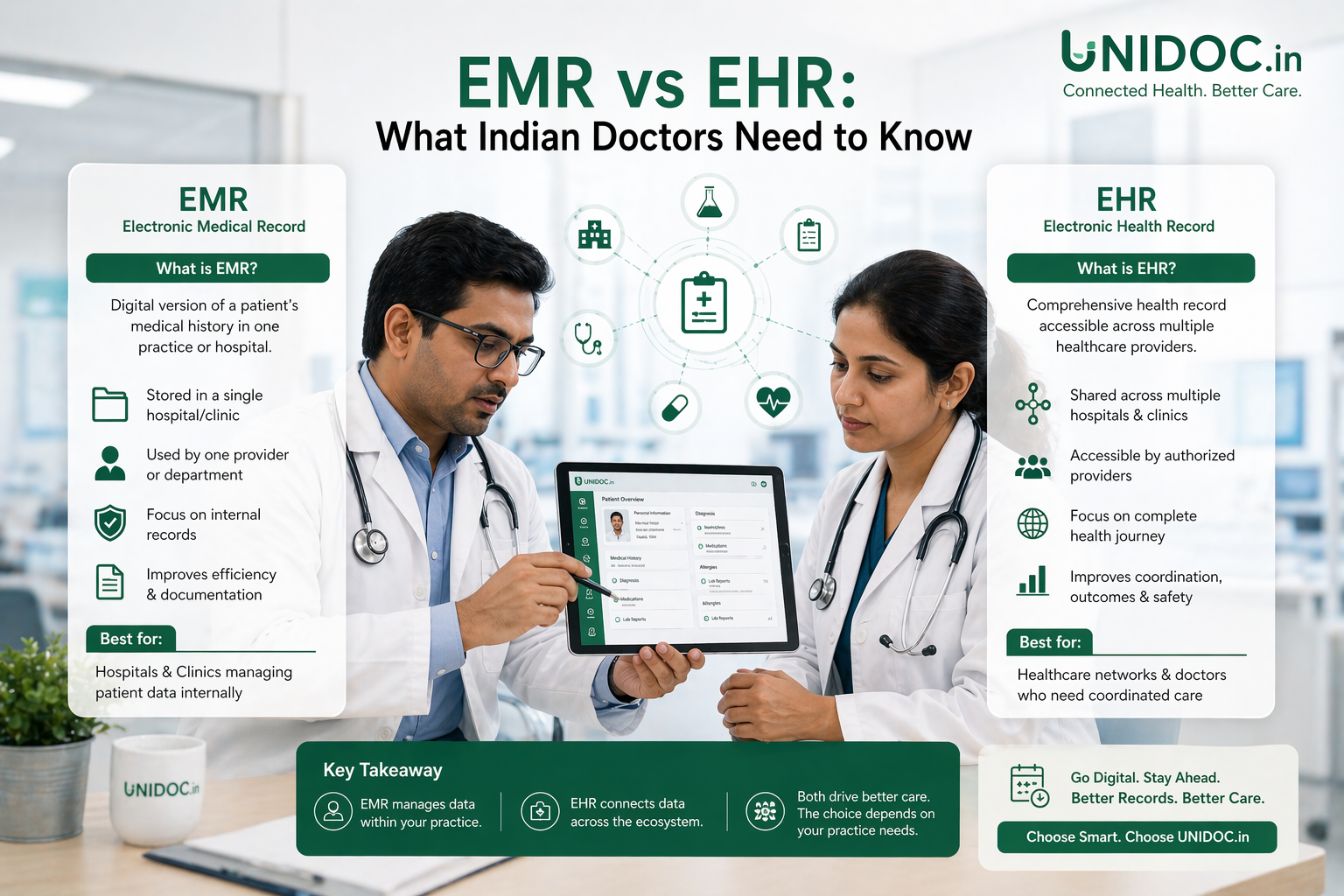
The State of Hospital Software in India Today
India's healthcare IT landscape is at an inflection point. For decades, hospitals have operated on a patchwork of disconnected systems — one vendor for OPD, another for billing, a separate system for lab management, and often no system at all for critical workflows like nurse handoffs or operation theater scheduling.
This fragmentation creates real problems: data silos, duplicate patient records, billing errors, compliance gaps, and an overall inability to deliver coordinated patient care. As we move through 2026, the pressure to modernize is coming from every direction — regulatory mandates, patient expectations, competitive dynamics, and operational economics.
Why Legacy Systems Are Failing
Most hospital management systems currently used in India were designed in a pre-ABDM, pre-AI era. They suffer from fundamental limitations:
- Monolithic architecture that cannot scale or integrate with modern APIs
- No mobile-first design — clinicians are tied to desktop workstations
- Zero AI capability — no clinical decision support, no predictive analytics
- ABDM integration as an afterthought — bolt-on modules that break constantly
- Poor user experience — interfaces designed by engineers, not clinicians
- Vendor lock-in with proprietary data formats and no export capability
Five Trends Defining HMS in 2026
1. Cloud-Native Platforms Replace On-Premise Servers
The debate between cloud and on-premise is effectively over for most healthcare organizations. Cloud-native platforms offer compelling advantages:
- Zero infrastructure cost — No servers to buy, maintain, or replace
- Automatic updates — Security patches and feature updates deploy seamlessly
- Scalability — Handle peak loads during flu season or pandemic surges
- Multi-branch access — All locations share a single, synchronized database
- Disaster recovery — Built-in redundancy eliminates data loss risk
However, some large hospital chains still prefer hybrid models with local data processing and cloud synchronization. Unidoc supports both architectures, giving hospitals the flexibility to choose what works for their compliance and latency requirements.
2. AI Becomes a Core Feature, Not an Add-On
In 2026, AI integration is the defining differentiator between modern HMS platforms and legacy systems. The most impactful AI applications include:
- AI Patient Summaries — Automatically generated clinical briefs that give doctors instant context during consultations and emergencies
- Clinical Decision Support — Real-time drug interaction checking, dose validation, and evidence-based treatment suggestions
- Predictive Analytics — Risk scoring for readmission, hospital-acquired infections, and deterioration alerts
- Natural Language Processing — Voice-to-text clinical documentation and natural language search across patient records
- Revenue Cycle Optimization — AI-driven coding suggestions and claim rejection prevention
3. Unified Platforms Replace Point Solutions
The era of best-of-breed point solutions is giving way to unified platforms that handle the entire healthcare workflow:
| Point Solution Approach | Unified Platform Approach |
|---|---|
| Separate OPD, IPD, Lab, Pharmacy systems | Single platform, single database |
| Multiple vendor relationships | One vendor, one contract |
| Data silos between departments | Seamless data flow across workflows |
| Complex integration maintenance | Built-in interoperability |
| Inconsistent user experience | Unified interface for all users |
Unidoc exemplifies this trend by offering OPD, IPD, lab management, pharmacy POS, billing, insurance claims, operation theater scheduling, and ABDM compliance in a single platform — eliminating the integration headaches that plague multi-vendor setups.
4. ABDM Compliance Drives Software Decisions
With ABDM milestones becoming enforceable requirements, compliance capability is now a primary factor in HMS selection. Hospitals are evaluating software not just on features and price, but on:
- Native ABHA creation and verification support
- Automatic FHIR bundle generation from clinical workflows
- Health Information Exchange (HIE) capability for bidirectional record sharing
- Consent management aligned with ABDM specifications
- Health Facility Registry (HFR) integration
Software that treats ABDM as a core architectural principle — rather than a bolted-on module — will dominate the market through 2026 and beyond.
5. Patient Experience Becomes a Software Metric
Modern HMS platforms are being evaluated on patient-facing features as much as clinical and administrative capabilities:
- WhatsApp notifications for appointment reminders, lab results, and prescription refills
- QR-based check-in that eliminates front-desk queues
- Digital payment integration for seamless billing
- Patient portals where patients access their records, reports, and prescriptions
- Feedback collection integrated into the discharge workflow
Cloud vs. On-Premise: A Practical Comparison
For hospitals still evaluating their deployment model, here is a practical comparison:
When Cloud Makes Sense
- Small to mid-size hospitals and clinics (up to 200 beds)
- Multi-branch operations needing centralized data
- Facilities without dedicated IT staff
- New setups wanting to go live quickly
- Organizations prioritizing cost predictability
When On-Premise or Hybrid Makes Sense
- Large tertiary care hospitals with existing data center infrastructure
- Facilities in areas with unreliable internet connectivity
- Organizations with strict data residency requirements
- Hospitals with dedicated IT teams capable of managing infrastructure
The Hybrid Approach
Unidoc's hybrid architecture offers the best of both worlds. Critical workflows run locally with near-zero latency, while data synchronizes to the cloud for backup, analytics, and multi-branch access. If internet connectivity drops, the system continues operating offline and syncs automatically when connectivity resumes.
What to Look for When Evaluating HMS in 2026
For hospital administrators and IT decision-makers, here is a practical evaluation framework:
- ABDM readiness — Does the system natively support all three milestones?
- AI capabilities — Are AI features built-in or promised for "future releases"?
- Deployment flexibility — Can you choose cloud, on-premise, or hybrid?
- Data portability — Can you export all data in standard formats if you switch vendors?
- Mobile access — Can clinicians use the system on tablets and phones?
- Integration ecosystem — Does it connect with lab instruments, pharmacy dispensing systems, and third-party applications?
- Total cost of ownership — Include implementation, training, customization, and ongoing support
- Implementation timeline — Can you go live in weeks, not months?
Unidoc's Vision for the Future
Unidoc is built for the healthcare challenges of 2026 and beyond. By combining a unified platform architecture with native ABDM compliance, clinical AI, and patient engagement tools, Unidoc delivers the complete hospital management system that Indian healthcare needs — without the complexity, cost, and integration headaches of legacy alternatives.
Explore how Unidoc can modernize your hospital operations. Request a personalized demo and see the future of hospital management in action.