The Confusion That Costs Clinics Money
Walk into any healthcare IT conference in India and you will hear vendors use "EMR" and "EHR" interchangeably. They are not the same thing — and the difference matters when you are choosing software for your practice.
Getting this wrong means you either overpay for features you do not need, or you buy a system that cannot grow with you.
EMR: The Digital Version of Your Paper Chart
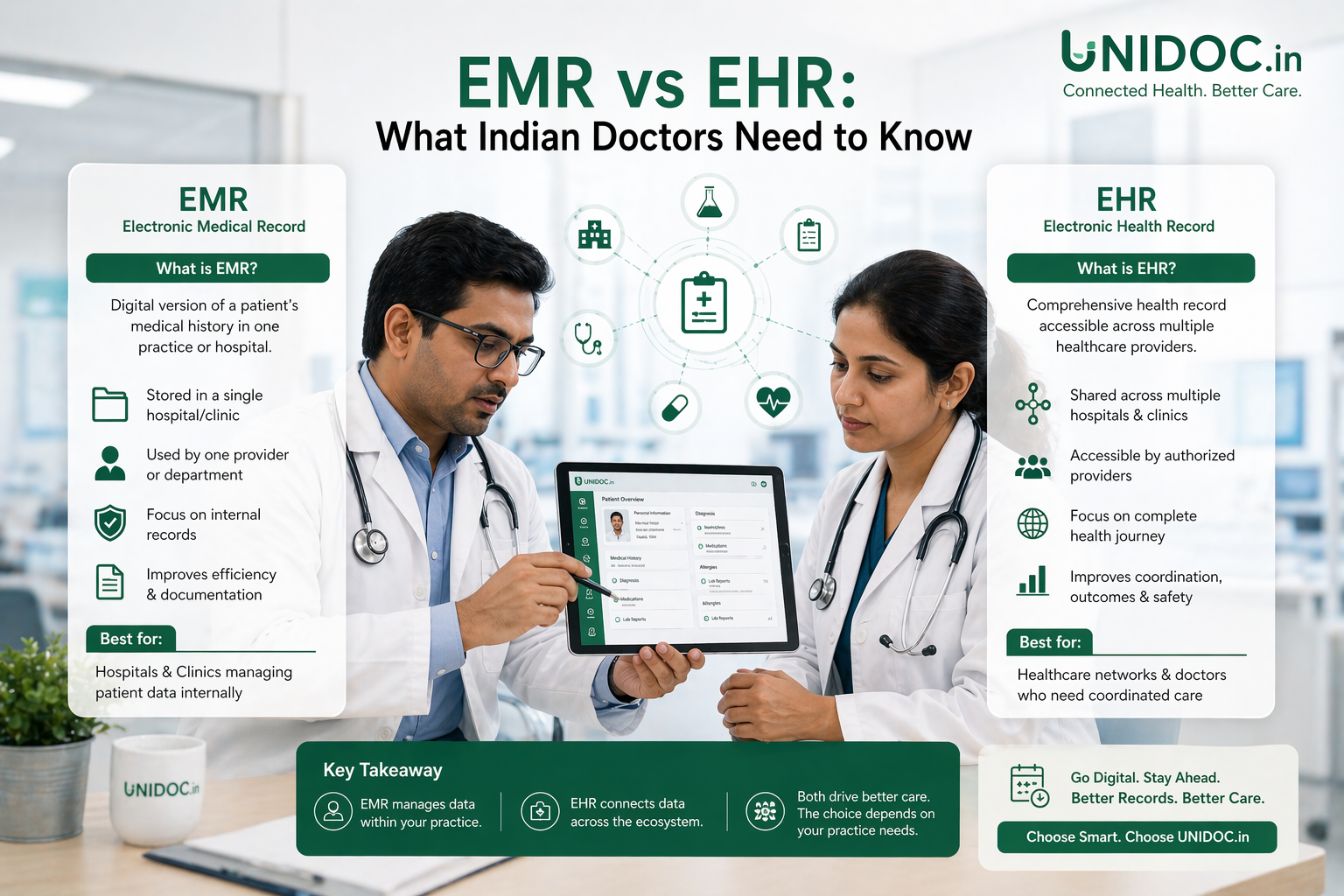
An Electronic Medical Record (EMR) is a digital version of the paper charts in a single clinic or hospital. It contains the medical and treatment history of patients within one practice.
Think of it as your clinic's internal notebook — digitised. It records:
- Patient demographics and visit history
- Doctor's clinical notes and prescriptions
- Lab orders placed from within the clinic
- Billing and payment records
The limitation: EMR data typically stays within your facility. If a patient visits another hospital, that hospital cannot access the EMR from your clinic. The data does not travel with the patient.
When an EMR Is Enough
An EMR works well for:
- Single-doctor clinics with no need to share records externally
- Specialty practices where patients are referred in and out via paper or phone
- Early-stage digitisation — moving from paper to digital for the first time
If your practice operates independently and referrals are handled manually, an EMR covers most of your needs at a lower cost.
EHR: The Patient's Complete Health Story
An Electronic Health Record (EHR) goes beyond one facility. It is designed to be shared across authorised providers — hospitals, labs, pharmacies, and even the patient themselves.
An EHR includes everything an EMR has, plus:
- Interoperability: Data can be exchanged with other systems using standards like FHIR and HL7
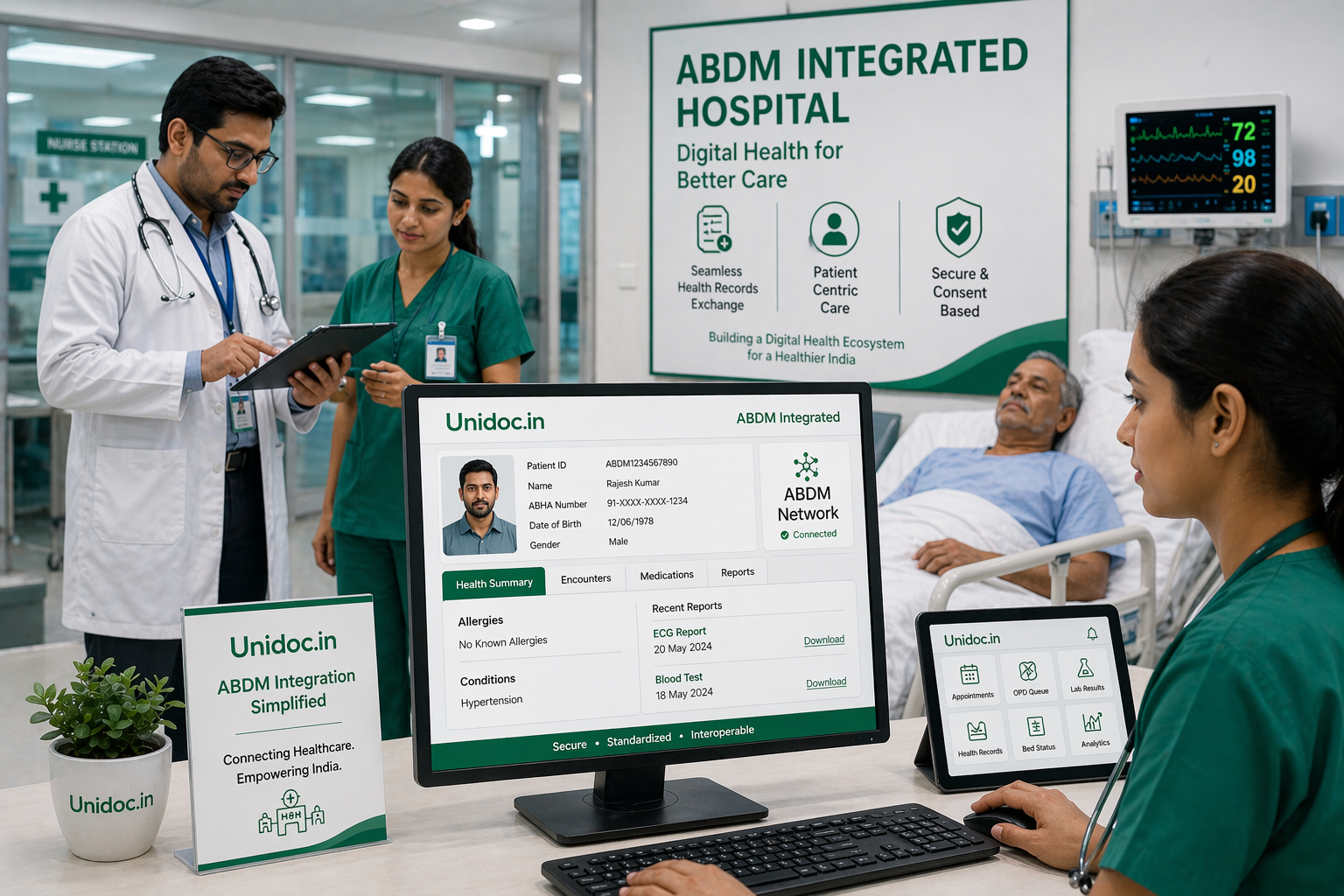
- ABDM compliance: Records can be linked to a patient's ABHA ID and shared on the national health network
- Multi-facility access: If a patient visits your hospital today and a specialist tomorrow, both see the same record
- Patient portal access: Patients can view their own records, download reports, and share them with other providers
When You Need an EHR
An EHR becomes essential when:
- You operate across multiple locations (chain of clinics, hospital + satellite centres)
- You need ABDM/ABHA compliance for government schemes or insurance
- Your patients are referred to external labs, specialists, or pharmacies that need access to clinical data
- You want to build a longitudinal patient record that follows the patient across their care journey
The Indian Context: Why This Matters Now
Three forces are pushing Indian healthcare toward EHR adoption:
1. ABDM Mandate
The Ayushman Bharat Digital Mission requires hospitals to support health information exchange. This is fundamentally an EHR capability — EMRs that cannot share data externally will not meet ABDM Milestone 3.
2. Insurance Digitalisation
TPA and insurance companies are increasingly requiring digital claim submission with structured clinical data. An EHR that generates standardised discharge summaries and links them to encounters makes cashless claims faster and reduces rejections.
3. Patient Expectations
Patients — especially in urban India — are beginning to expect digital access to their records. They want to download lab reports, share prescriptions with pharmacies via WhatsApp, and carry their medical history when they switch doctors.
The Real Decision Framework
Instead of asking "EMR or EHR?", ask these three questions:
| Question | If Yes → | If No → |
|---|---|---|
| Do patients visit multiple facilities in your network? | EHR | EMR may suffice |
| Do you need ABDM/ABHA compliance? | EHR | EMR for now |
| Do external labs or pharmacies need access to your data? | EHR | EMR |
If you answered "yes" to even one, you need EHR-level capability. The good news: modern systems like Unidoc provide EHR functionality at EMR-level pricing — so you do not need to compromise.
What to Look for in an EHR for India
Not all EHR systems are built for Indian workflows. Here is what matters:
- ABDM-native: Built-in ABHA ID generation, health record linking, and consent management — not bolted on as a plugin
- FHIR R4 + HL7 support: These are the standards that enable data exchange. If the software cannot speak FHIR, it cannot interoperate
- ICD-10 coding: Standardised diagnosis codes are essential for insurance claims and clinical analytics
- Regional language support: Clinical documentation in Hindi, Gujarati, Tamil, and other languages
- Affordable for small clinics: Enterprise EHR pricing does not work for a 2-doctor clinic in a Tier 2 city
The Unidoc Position
Unidoc is an EHR-grade system designed for Indian clinics and hospitals of any size. Every patient record is ABHA-linkable, every encounter is FHIR-exportable, and the pricing is designed for practices from solo practitioners to 200-bed hospitals.
Whether you are a single-doctor clinic making the jump from paper, or a multi-speciality hospital consolidating fragmented systems — the clinical record layer is the same.
Want to see how Unidoc handles patient records? Book a demo and we will walk you through it.