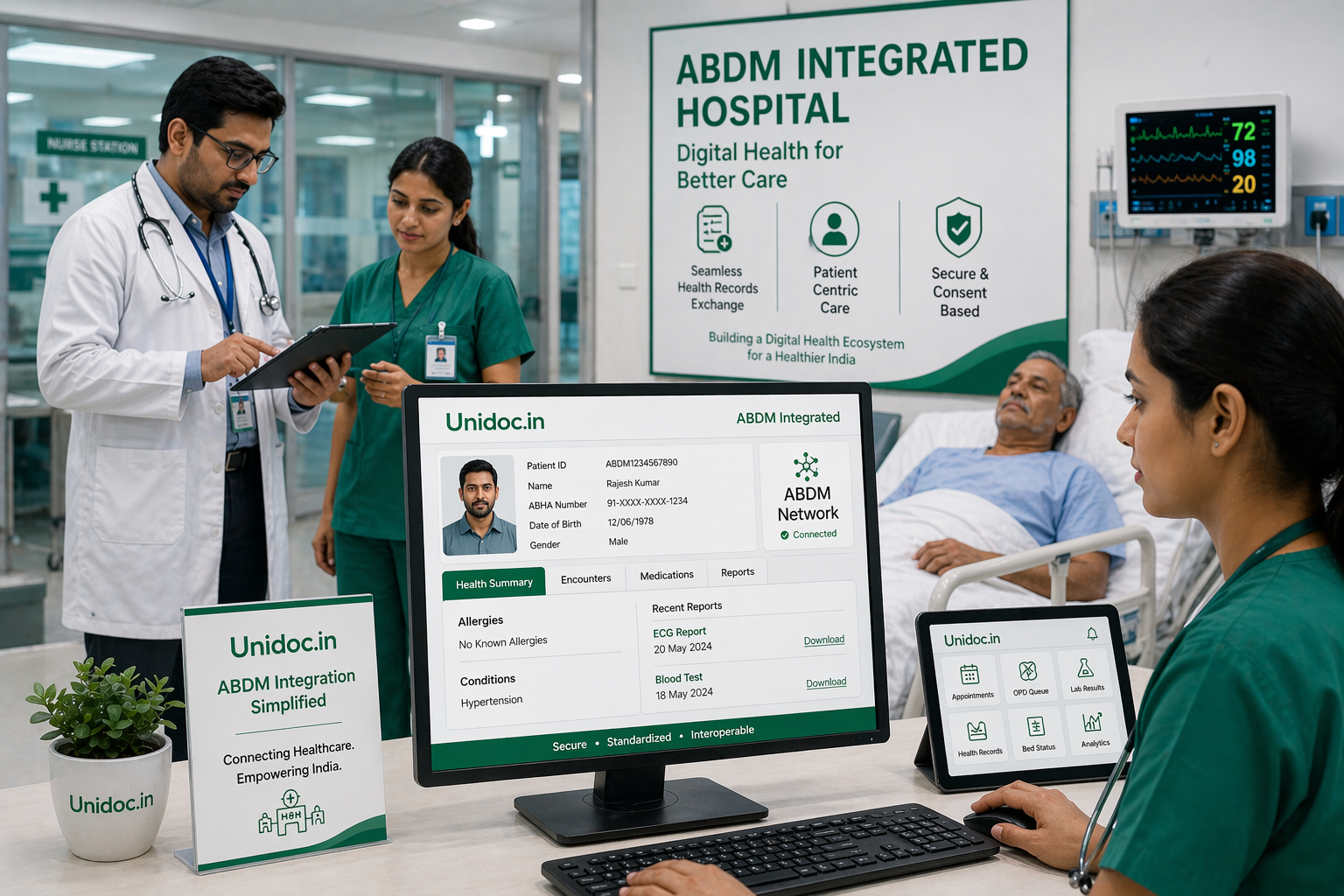
What Is ABDM and Why Should Hospitals Care?
The Ayushman Bharat Digital Mission (ABDM) is the Indian government's flagship initiative to create a unified digital health ecosystem across the country. Launched by the National Health Authority (NHA), ABDM aims to connect patients, hospitals, clinics, labs, and pharmacies through a standardized digital infrastructure.
For hospitals still relying on fragmented paper records or legacy software, the window to act is closing fast. With compliance deadlines approaching and government incentives tied to adoption milestones, understanding ABDM is no longer optional — it is a strategic imperative.
The Three Milestones Every Hospital Must Know
ABDM compliance is structured into three progressive milestones, each building on the previous one:
-
Milestone 1 — ABHA Registration & Verification: Hospitals must enable patients to create or link their ABHA (Ayushman Bharat Health Account) IDs during registration. This is the foundational step that connects patients to the digital health ecosystem.
-
Milestone 2 — Health Record Linking: Clinical records generated during visits — prescriptions, lab reports, discharge summaries — must be digitized and linked to the patient's ABHA ID. This allows patients to access their records through any ABDM-compliant application.
-
Milestone 3 — Health Information Exchange: The most advanced milestone requires hospitals to support bidirectional data exchange. Authorized providers can request and receive patient records from other ABDM-linked facilities, enabling truly portable health records.
The Real Cost of Non-Compliance
Hospitals that delay ABDM integration face several tangible risks:
- Loss of government empanelment for Ayushman Bharat and other public health schemes
- Reduced patient trust as digitally aware patients prefer ABDM-linked facilities
- Operational inefficiency from maintaining parallel paper and digital workflows
- Missed interoperability with labs, pharmacies, and referral hospitals already on the network
- Potential penalties as regulatory enforcement tightens through 2026 and beyond
What Patients Actually Expect
Today's patients, especially in urban India, expect their medical records to follow them. They want to share lab results with a specialist without carrying paper files. They want their prescription history accessible at any pharmacy. ABDM makes this possible, but only if hospitals participate.
How Unidoc Makes ABDM Integration Effortless
Unidoc was architecturally designed from the ground up to be ABDM-compliant. Unlike legacy systems that bolt on ABDM as an afterthought, Unidoc embeds compliance into every workflow.
Seamless ABHA Creation and Linking
With Unidoc, front-desk staff can create or verify a patient's ABHA ID during registration in under 30 seconds. The system supports multiple authentication methods — Aadhaar OTP, mobile OTP, and demographic verification — ensuring coverage for all patient demographics.
Automatic Health Record Generation
Every clinical interaction in Unidoc — from OPD consultations and digital prescriptions to lab reports and discharge summaries — automatically generates FHIR-compliant health records. These records are structured according to NHA specifications and linked to the patient's ABHA ID without any extra steps from the clinician.
Built-In Health Information Exchange
Unidoc supports the full Health Information Exchange and Consent Manager (HIE-CM) workflow. When an authorized provider requests records, the patient receives a consent notification. Upon approval, records are securely shared through encrypted channels — all within the ABDM framework.
Timeline: Where Should Your Hospital Be Right Now?
Here is a practical readiness checklist for hospitals in 2026:
- Already done: Registered as a Health Facility on the Health Facility Registry (HFR)
- Q1 2026: Milestone 1 live — ABHA creation integrated into patient registration
- Q2 2026: Milestone 2 live — All clinical records linked to ABHA IDs
- Q3-Q4 2026: Milestone 3 live — Full health information exchange capability
The Advantage of Starting Now
Hospitals that adopt ABDM early gain a competitive edge. They appear in the ABDM facility directory, attract digitally savvy patients, and streamline referral workflows with partner institutions. Early adopters also benefit from NHA support and troubleshooting resources before demand peaks.
Beyond Compliance: The Strategic Value
ABDM integration is not just about ticking regulatory boxes. It fundamentally improves how hospitals operate:
- Reduced duplicate tests when incoming records show recent lab work
- Faster emergency care with instant access to patient histories via ABHA
- Improved care continuity across multi-specialty and multi-branch setups
- Data-driven insights from structured, standardized health records
- Enhanced reputation as a digitally forward healthcare provider
Getting Started with Unidoc
Unidoc offers a complete ABDM integration package that takes most hospitals from zero to Milestone 3 compliance in under 8 weeks. The platform handles the technical complexity — FHIR bundle generation, consent management, HIP/HIU registration — so your team can focus on patient care.
Ready to make your hospital ABDM-compliant? Get in touch with the Unidoc team to schedule a demo and see how seamless compliance can be.