What Is NABH and Why Does It Matter?
The National Accreditation Board for Hospitals & Healthcare Providers (NABH) is the gold standard for hospital quality in India. Accreditation signals to patients, insurers, and regulators that your facility follows evidence-based clinical protocols, maintains proper documentation, and prioritises patient safety.
But for most hospitals — especially mid-sized and smaller ones — the accreditation process feels overwhelming. The sheer volume of documentation, audit trails, checklists, and policy requirements creates a compliance burden that stretches administrative teams thin.
This is where digital software changes the equation entirely.
The Documentation Problem
NABH requires hospitals to maintain documentation across dozens of standards. Some of the most commonly cited pain points:
- Patient consent forms must be documented and stored for every procedure
- Medication administration records need timestamps and nurse signatures
- Clinical handover notes between shifts must be recorded
- Infection control logs require daily entries and monthly audits
- Adverse event reports must follow a structured format with root cause analysis
When this is done on paper, hospitals end up with rooms full of files, inconsistent formatting, and gaps that become visible only during audits — when it is too late to fix them.
What Auditors Actually Look For
NABH assessors are not just checking whether documents exist. They are verifying:
- Consistency — Are protocols followed uniformly across departments?
- Timeliness — Were notes recorded at the time of care, or backdated?
- Traceability — Can you trace a patient's journey from admission to discharge?
- Completeness — Are all required fields filled, signed, and countersigned?
Paper-based systems fail on all four counts because they depend entirely on human discipline with no system-level enforcement.
How Digital Software Solves NABH Compliance
A properly designed HMS does not just digitise paper forms. It enforces compliance by design — making it harder to skip steps than to complete them.
1. Mandatory Field Enforcement
Digital forms can require fields to be completed before a record is saved. A discharge summary cannot be finalised without a diagnosis code. A medication order cannot proceed without allergy verification. The system enforces what paper cannot.
2. Timestamped Audit Trails
Every action in a digital system is automatically timestamped with the user identity. No more questions about when a note was written or who signed off on a prescription. Auditors can verify timelines instantly.
3. Automated Checklist Generation
NABH requires department-specific checklists — surgical safety checklists, infection control rounds, fire safety drills. Digital systems can auto-generate these at the correct intervals and flag overdue items to department heads.
4. Real-Time MRD Compliance
The Medical Records Department (MRD) is one of the most scrutinised areas during NABH assessments. A digital HMS can auto-populate MRD checklists from encounter data — verifying that every discharge record contains the required elements without manual review.
5. Policy Document Management
NABH requires hospitals to maintain and regularly update Standard Operating Procedures (SOPs). A digital document management system tracks versions, requires acknowledgement from staff, and alerts administrators when a policy is due for review.
The Unidoc Approach to NABH
Unidoc was built with NABH compliance as a core design requirement, not an afterthought. Here is what that means in practice:
- Auto MRD Checklist: Every discharge record is automatically checked against NABH documentation requirements. Missing items are flagged before the record is closed
- Role-Based Access: Granular permissions ensure that only authorised personnel can access, edit, or sign clinical records — a key NABH requirement
- Complete Audit Trail: Every clinical action — from prescription to lab order to discharge — is logged with user, timestamp, and IP address
- ICD-10 Coding: Diagnoses are coded using ICD-10 standards, ensuring consistency in clinical documentation and enabling accurate reporting
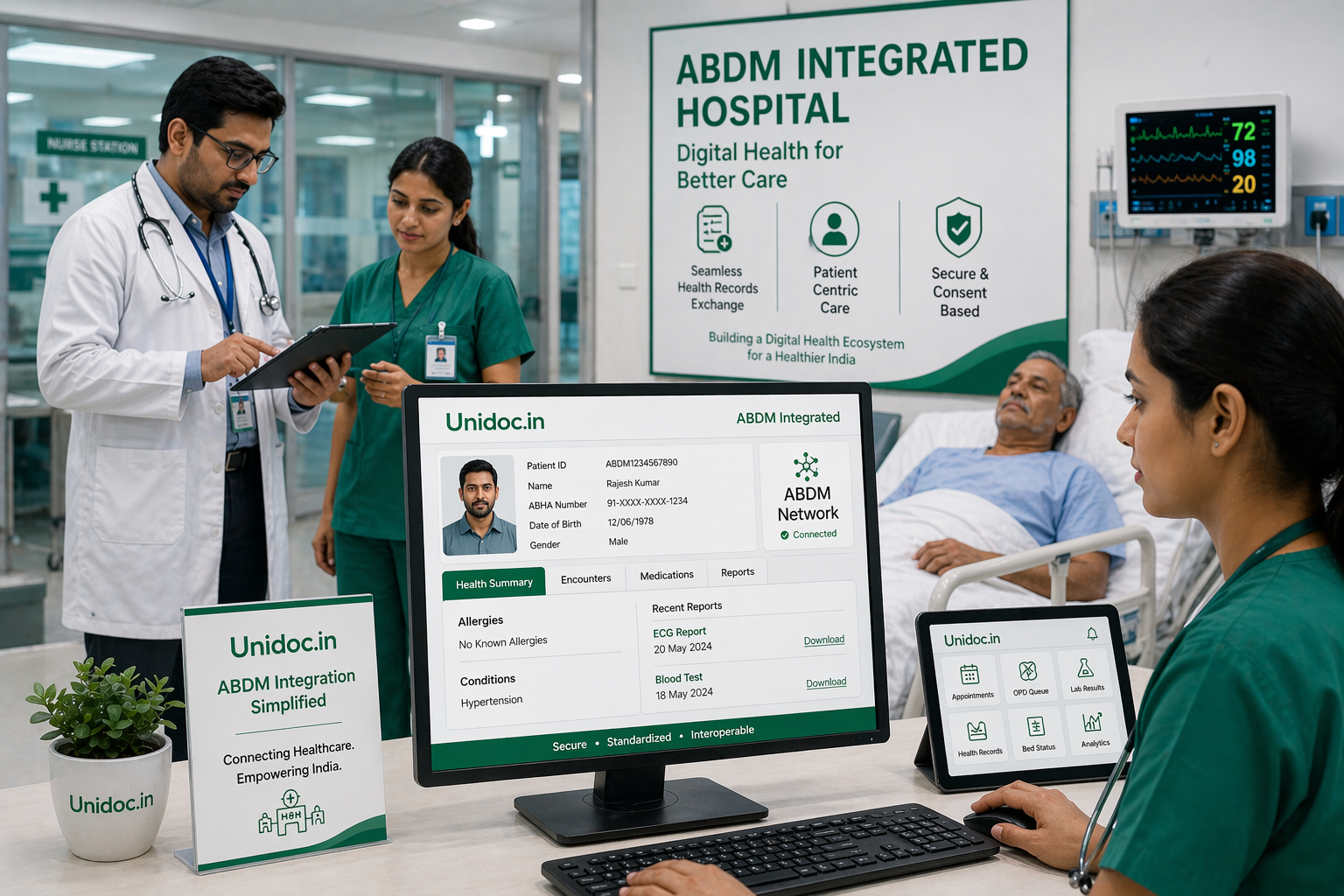
- ABDM Integration: Patient records are linked to ABHA IDs and available for health information exchange as required by government mandates
A Practical NABH Readiness Checklist
If your hospital is preparing for NABH accreditation, here is a digital readiness checklist:
| Area | Paper Risk | Digital Solution |
|---|---|---|
| Patient Registration | Missing demographics | Mandatory field forms |
| Clinical Notes | Illegible handwriting | Structured digital templates |
| Medication Orders | No allergy cross-check | Auto drug interaction alerts |
| Discharge Summary | Incomplete documentation | Auto MRD checklist enforcement |
| Consent Forms | Lost or unsigned | Digital consent with timestamps |
| Infection Control | Irregular logging | Scheduled digital checklists |
| Staff Credentialing | Expired documents | Auto-renewal alerts |
The Cost of Waiting
Hospitals that attempt NABH preparation in the last 3–6 months before assessment typically spend 2–3x more on consultants, temporary staff, and remediation. The documentation backlog alone can take months to clear.
Starting with a compliant digital system from day one means your hospital is always audit-ready — not scrambling before the assessor arrives.
Getting Started
If your hospital is considering NABH accreditation — or preparing for re-accreditation — the single highest-impact step you can take is to move clinical documentation to a system that enforces compliance by design.
Unidoc offers a free compliance readiness assessment for hospitals exploring accreditation. Our team walks through your current workflows and identifies gaps before you begin the formal NABH journey.
Ready to make your hospital NABH-ready? Contact our team for a free compliance assessment.